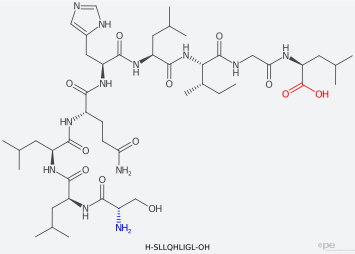
Structure of PRAME 425-433 (HLA-A*02:01)
Logo for Cancer
Cancer

PRAME 425-433 (HLA-A*02:01)

€105.00*

Prices excl. VAT plus shipping costs
Available, delivery time: 1-3 days
sterile and endotoxin free
Delivery Format: The product is supplied freeze dried.
Purity: 95% HPLC-MS
Caution: For research use only. Not for use in humans.
Amount in mg
1
Add to Cart
Product number: EP08114_1

Description

PRAME 425-433 (SLLQHLIGL) is a linear peptidic epitope (epitope ID 459114) studied as part of Preferentially Expressed Antigen in Melanoma (PRAME, UniProt:P78395), a cancer/testis antigen from Homo sapiens. PRAME is highly expressed in several solid tumors such as melanoma, epithelial ovarian cancer, multiple sarcoma subtypes and non-small cell lung cancer, while in healthy tissue it is almost exclusively restricted to the testicles. Therefore, it is a promising target for adoptive T cell therapies. 

PRAME 425-433 (SLLQHLIGL) was first described by Kessler et al. in 2001. In their experiments, cytotoxic T lymphocytes recognizing the high affinity binding, HLA-A*0201–restricted PRAME epitope specifically lysed melanoma, renal cell, lung, mammary, and cervical carcinoma cell lines.

TechData

Sequence: SLLQHLIGL
Gene: PRAME
Delivery: 1-3 days
C-Terminus: OH
N-Terminus: H
Amount: 1 mg
Counterion: TFA
Protein: Melanoma antigen preferentially expressed in tumors
IEDB Id: https://www.iedb.org/epitope/459114
Species: Human
Allele: HLA-A*02:01
Application: Flow Cytometry
Indication: Cancer
Purity: 95% HPLC-MS

More PRAME peptides

PRAME 100-108 (HLA-A*02:01) ( VLDGLDVLL )
The PRAME 100-108 peptide with the amino acid sequence VLDGLDVLL is a linear epitope (epitope ID 869501) derived from the Preferentially Expressed Antigen in Melanoma (PRAME, UniProt:P78395). It is used to stimulate human Prame (100-108)-specific CD8+T cells. PRAME belongs to the cancer/testis antigens in Homo sapiens. This antigen is notably overexpressed in various solid tumors, including melanoma, epithelial ovarian cancer, multiple sarcoma subtypes, and non-small cell lung cancer, while its expression in healthy tissues is mostly restricted to the testes. The PRAME 100-108 (VLDGLDVLL) epitope is presented by the MHC class I HLA-A*02:01 allele and was initially identified by Kessler et al. in 2001. In their studies, they demonstrated that cytotoxic T lymphocytes, which recognize this high-affinity binding epitope, could specifically target and lyse melanoma, lung, mammary, renal cell and cervical cancer cell lines.

From €105.00*
PRAME 242-251 (HLA-A*3) ( CTWKLPTLAK )
#

From €105.00*
PRAME 254-262 (HLA-A24), human ( PYLGQMINL )
#

From €105.00*
PRAME 300–309 (HLA-A*02:01) ( ALYVDSLFFL )
ALYVDSLFFL is a linear peptidic epitope (epitope ID225231) studied as part of Melanoma antigen preferentially expressed in tumors from Homo sapiens (human), tested in T cell assays. Antigen Peptide PRAME 300–309 (HLA-A*02:01) ALYVDSLFFL for stimulation of antigen-specific T cells in T cell assays such as ELISPOT, ICS, cytotoxity or proliferation assays.

From €105.00*
PRAME 301-309 (HLA-A*24) ( LYVDSLFFL )
#

From €105.00*
PRAME 425-433 (HLA-A*02:01) ( SLLQHLIGL )
PRAME 425-433 (SLLQHLIGL) is a linear peptidic epitope (epitope ID 459114) studied as part of Preferentially Expressed Antigen in Melanoma (PRAME, UniProt:P78395), a cancer/testis antigen from Homo sapiens. PRAME is highly expressed in several solid tumors such as melanoma, epithelial ovarian cancer, multiple sarcoma subtypes and non-small cell lung cancer, while in healthy tissue it is almost exclusively restricted to the testicles. Therefore, it is a promising target for adoptive T cell therapies.  PRAME 425-433 (SLLQHLIGL) was first described by Kessler et al. in 2001. In their experiments, cytotoxic T lymphocytes recognizing the high affinity binding, HLA-A*0201–restricted PRAME epitope specifically lysed melanoma, renal cell, lung, mammary, and cervical carcinoma cell lines.

From €105.00*
PRAME/OIP4 Peptide Pool, human
Pool of 125 overlapping peptides derived from a peptide scan (15mers with 11 aa overlap) through Melanoma antigen preferentially expressed in tumors (PRAME/OIP4) (UniProt ID: P78395) of Homo sapiens (Human). One unit allows the stimulation of 2,5 x 10⁸ cells.You can find applications and references in our blog post: Esophagogastric adenocarcinoma: Tumor-associated antigens, immune responses and HLA-I Expression

€285.00*