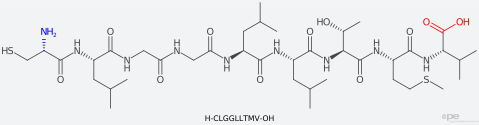

EBV LMP-2 426-434 (HLA-A*02:01) CLGGLLTMV
€ 105.00 *
Description
The EBV LMP-2 426–434 peptide (Sequence: CLGGLLTMV) is a highly characterized, immunodominant linear epitope derived from the Latent Membrane Protein 2 (LMP-2, UniProt ID: P13285) of Epstein-Barr Virus (EBV / Human Herpesvirus 4).
Restricted to HLA-A*02:01, this peptide serves as an essential tool for monitoring virus-specific T-cell immunity, evaluating memory CD8+ T-cell responses, and validating immunoncology or vaccine platforms targetting EBV-associated malignancies.
Key Features & Applications
Extensively Validated: Documented in over 115 scientific publications and evaluated across 240+ T-cell assays and 30+ MHC ligand assays (IEDB Epitope ID: 6568).
Structural Precision: Solved 3D crystal structure available (PDB ID: 3REW) for precise molecular modeling and binding affinity analysis.
Assay Compatibility: Ideal for use in ELISpot, ICS (Intracellular Cytokine Staining), tetramer staining, and functional T-cell activation assays.
Cross-Referenced Control Pools
This catalog peptide is also available as a core component in the following off-the-shelf peptides&elephants control pools:
TechData
| Sequence: | CLGGLLTMV |
| Gene: | LMP2 |
| Delivery: | 2-5 days |
| C-Terminus: | OH |
| N-Terminus: | H |
| Amount: | 1 mg |
| Counterion: | TFA |
| Protein: | Latent membrane protein |
| UniProt Id: | P13285 |
| IEDB Id: | 6568 |
| Species: | Epstein-Barr virus (EBV; Human herpesvirus 4) |
| Allele: | HLA-A*02:01 |
| Application: | T-cell assays, Immune monitoring, Antigen specific T-cell stimulation, T-cell expansion, Cellular immune response |
| Indication: | Infectious disease, Cancer, Neuroscience |
| Purity: | 95% HPLC-MS |
Documents
References
Bonifacius, Agnes, et al. "Next-generation LMP2A-targeting TCR-recombinant T cells with inducible IL-18 expression to treat EBV-associated malignancies." Molecular Therapy Oncology 34.3 (2026).
Ning, Jianfang et al. “Functional virus-specific memory T cells survey glioblastoma.” Cancer immunology, immunotherapy : CII vol. 71,8 (2022): 1863-1875. doi:10.1007/s00262-021-03125-w
More EBV LMP peptides