Epstein-Barr virus: Mechanisms of cancer development decoded


Over 90 percent of adults worldwide are infected with the Epstein-Barr virus (EBV). The virus belongs to the herpes viruses and stays in the body for a lifetime. It causes glandular fever, but it can also develop into Hodgkin's or non-Hodgkin's lymphoma after several years of reactivations. The circumstances under which this happens have not yet been clarified. Scientists led by Hannes Vietzen and Elisabeth Puchhammer-Stöckl from the Center for Virology at the Medical University of Vienna, Austria, have examined the mechanisms more closely and published their results in the specialist journal Frontiers in Immunologie. [1] The scientists suspected an immune escape mechanism, in which the LMP-1 peptide of the Epstein-Barr virus plays a central role. Peptides&elephants synthesized the LMP-1 peptide for the research group's investigations. The polymorphic peptide is produced by the Epstein-Barr virus while it persists in the infected cells.

The LMP-1 peptide causes the infected cells to place more leukocyte antigen E (HLA-E) on their surface. The natural killer cells (NK) recognize the leukocyte antigen E and adjust their activity accordingly: If the natural killer cells bind to the leukocyte antigen E via their NKG2A receptor, they classify the cells as healthy and reduce their activity. If, on the other hand, the NKG2C receptor comes into play, the natural killer cells increase their activity. But in what way is this significant for the development of cancer?

Special LMP-1 and HLA-E variants meet impaired NK receptors

Vietzen and colleagues recruited 63 patients with EBV-positive Hodgkin's and non-Hodgkin's lymphoma for their study and 192 controls. In the controls, the Epstein-Barr virus had reactivated several times, but no lymphoma had developed. The scientists examined blood samples from the subjects using genetic association approaches and functional in vitro natural killer cell assays.

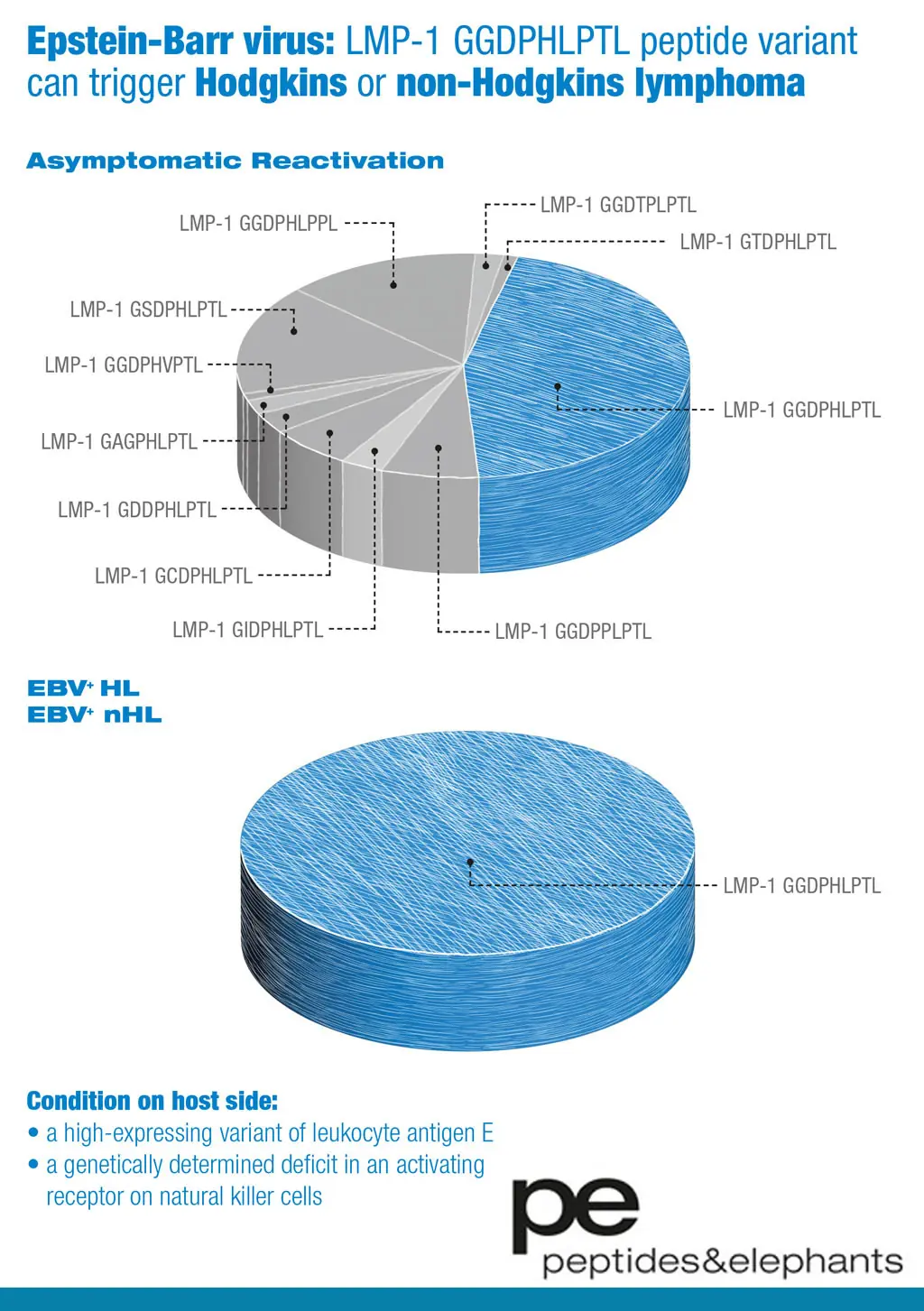
The results were groundbreaking: in the lymphoma patients, only those strains of the Epstein-Barr virus reactivated that formed the high-affin LMP-1 GGDPHLPTL peptide variant. In addition, the infected cells of the patients had significantly more leukocyte antigen E of the high-expressing variant *0103/0103 on their surface. The combination of both variants efficiently inhibited the activity of natural killer cells that possess the NKG2A receptor.
At the same time, the activity of the natural killer cells with NKG2C receptor was impaired in the lymphoma patients. For genetic reasons, about a third of the European population forms fewer or no NKG2C receptors on their natural killer cells. Those affected lack immune-stimulation via leukocyte antigen E.
pe-epstein-barr-Infografik

Monoclonal antibodies prevent immune escape

Due to the resulting immune tolerance via the NKG2A receptor on the one hand and the lack of immune activation via the NKG2C receptor on the other hand, infected tumor cells were able to spread easily in the in vitro studies of the research group. When the scientists blocked the NKG2A receptor using monoclonal antibodies (monalizumab), the natural killer cells controlled the growth of the infected tumor cells efficiently.

The scientists at the Medical University of Vienna were able to elucidate the LMP-1/HLA-E/NKG2A signaling pathway as central to the development of EBV-positive Hodgkins or non-Hodgkins lymphoma. The Epstein-Barr virus can trigger lymphoma when certain molecule variants of the signaling pathway come together on virus and host side - AND there is a genetically determined deficit in the activating NKG2C receptor of the natural killer cells.

Literature

  1. Vietzen H et al. Inhibitory NKG2A+ and absent activating NKG2C+ NK cell responses are associated with the development of EBV+ lymphomas. Front Immunol. 2023 Jun 22;14:1183788.
Skip product gallery

Related products

EBV (BZLF1) Peptide Pool
Peptide pool of 59 overlapping peptides derived from a peptide scan (15mers with 11 aa overlap) through Trans-activator protein BZLF1 (UniProt ID: P03206) of Epstein-Barr virus (HHV4) for T cell assays. One unit allows the stimulation of 2,5 x 10⁸ cells.

€277.50*
EBV (EBNA-3a) Peptide Pool
The EBV (EBNA-3a) Peptide Pool from peptides&elephants is designed for in vitro T cell stimulation and epitope analysis in research on Epstein-Barr virus (EBV, HHV-4). This pool contains 234 synthetic 15-mer peptides, overlapping by 11 amino acids, and spans the complete sequence of EBNA-3a (Epstein-Barr nuclear antigen 3a; UniProt ID: P12977). Each unit enables the stimulation of up to 2.5 × 10⁸ peripheral blood mononuclear cells (PBMCs) and is ideal for use in ELISpot, intracellular cytokine staining (ICS), and flow cytometry-based T cell assays. Scientific Background EBV is a ubiquitous herpesvirus that infects more than 90% of the global population. It is the causative agent of infectious mononucleosis and is closely associated with several B cell malignancies, including post-transplant lymphoproliferative disease (PTLD), diffuse large B cell lymphoma (DLBCL), Burkitt lymphoma, and Hodgkin lymphoma. During latency, EBV can enter different gene expression programs. Latency type III, in which all nine latent proteins are expressed, is the only form capable of transforming B cells in vitro, resulting in lymphoblastoid cell lines (LCLs). Among these latency proteins, EBNA-3a plays a supportive but non-essential role in B cell transformation: EBV mutants lacking EBNA-3a can still transform B cells, but with significantly reduced efficiency. EBNA-3a–deficient LCLs proliferate more slowly and show increased apoptosis compared to wild-type virus–derived LCLs. EBNA-3a appears to regulate a subset of cellular genes, some of which overlap with those regulated by EBNA2. The two proteins can act antagonistically or cooperatively to control gene expression. These findings position EBNA-3a as a key modulator of B cell proliferation and survival during EBV latency, and as a relevant CD8⁺ T cell target in both basic immunological studies and translational research.

€301.30*
EBV (EBNA-3b) Peptide Pool
Peptide pool of 234 overlapping peptides derived from a peptide scan (15mers with 11 aa overlap) through Epstein-Barr nuclear antigen 4 (EBNA3b) (UniProt ID: Q1HVG4) of Epstein-Barr virus (HHV4) for T cell assays. One unit allows the stimulation of 2,5 x 10⁸ cells.

€301.30*
EBV (GP350/GP340) Peptide Pool
Peptide pool of 224 overlapping peptides derived from a peptide scan (15mers with 11 aa overlap) through Envelope glycoprotein GP350/GP340 (UniProt ID: P03200) of Epstein-Barr virus (EBV, Humanes Herpesvirus 4, HHV4). One unit allows the stimulation of 2,5 x 10⁸ cells. gp350/gp340 versus gp350/220 The EBV envelope glycoprotein gp350/gp340 (or gp350/220) is encoded by the BLLF1 gene and represents one of the most abundant surface proteins of the virion. The protein exists in multiple isoforms generated by alternative splicing. While gp350 denotes the full-length form, gp340 and gp220 refer to truncated isoforms of the same glycoprotein, which retain identical biological function. Differences in naming (gp340 vs. gp220) arise from historical nomenclature, experimental detection methods, and variations in glycosylation state.  Initial attachment and endocytosis Gp350/gp340 belongs to the core set of EBV glycoproteins that define viral tropism and host cell interaction – together with gp42, BMRF2, gH/gL, and gB. Gp350/gp340 plays a central role in viral attachment and entry into B lymphocytes. Through molecular mimicry of complement components, gp350/gp340 specifically recognizes complement receptor 1 (CR1/CD35) and complement receptor 2 (CR2/CD21) on B cells. This interaction mediates the initial attachment of EBV particles and triggers endocytosis of the immobilized virion, marking the first step of EBV infection in B lymphocytes. Major target of immune responses Due to its surface exposure, high abundance, and essential role in viral entry, gp350/gp340 represents a major target of humoral and cellular immune responses. Peptides derived from gp350/gp340 are widely used to study EBV-specific T cell immunity, epitope recognition, and immune monitoring in the context of EBV infection, EBV-associated malignancies, and vaccine development. The EBV (gp350/gp340) Peptide Pool from peptides&elephants provides comprehensive sequence coverage of this key viral glycoprotein and is ideally suited for applications such as T cell stimulation assays, epitope mapping, and immunological profiling in EBV research.

€301.30*
EBV (LMP1) Peptide Pool
Peptide pool of 94 overlapping peptides derived from a peptide scan (15mers with 11 aa overlap) through Latent membrane protein 1 (LMP1) (UniProt ID: P03230) of Epstein-Barr virus (HHV4) for T cell assays. One unit allows the stimulation of 2,5 x 10⁸ cells.

€333.20*
EBV (LMP2) Peptide Pool
The EBV (LMP2) Peptide Pool from peptides&elephants is designed for advanced T cell stimulation and epitope mapping in immunological studies of Epstein-Barr virus (EBV, HHV-4). This peptide pool consists of 122 synthetic 15-mer peptides, overlapping by 11 amino acids, and covers the full sequence of the Latent Membrane Protein 2 (LMP2) (UniProt ID: P13285). LMP2 is a latency-associated antigen commonly expressed in EBV-related malignancies such as nasopharyngeal carcinoma and Hodgkin’s lymphoma. It is a known target of both CD4⁺ and CD8⁺ T cell responses. Each unit of the peptide pool allows for the stimulation of up to 2.5 × 10⁸ peripheral blood mononuclear cells (PBMCs) and is optimized for use in T cell assays, such as ELISpot, intracellular cytokine staining (ICS), and flow cytometry-based functional readouts. Scientific Background LMP2 is one of the most clinically relevant antigens for therapeutic EBV vaccine development, particularly in the context of EBV-associated cancers such as nasopharyngeal carcinoma, Hodgkin lymphoma, and post-transplant lymphoproliferative disease (PTLD). Therapeutic vaccine candidates using viral vectors encoding LMP2 have successfully induced virus-specific CD8⁺ T cell responses in early-phase clinical trials. Furthermore, adoptive T cell therapies like posoleucel also target LMP2 alongside other latency proteins such as EBNA1, reinforcing its significance as a conserved and immunodominant antigen. This peptide pool is an ideal tool for: Characterizing patient-specific or vaccine-induced T cell responses Ex vivo stimulation of EBV-specific T cells Epitope screening and immune profiling Immune monitoring in clinical trials of EBV-targeted vaccines or adoptive T cell therapies

€340.70*
EBV (LMP2A) Peptide Pool
Peptide pool of 27 overlapping peptides derived from a peptide scan (15mers with 11 aa overlap) through Latent membrane protein 2A (LMP2A) (UniProt ID: A8CDV5) of Epstein-Barr virus (HHV4) for T cell assays. One unit allows the stimulation of 2,5 x 10⁸ cells.

€237.50*
Tip
EBV BARF1 Peptide Pool
Peptide pool of 53 overlapping peptides derived from a peptide scan (15mers with 11 aa overlap) through Secreted protein BARF1 (UniProt: P03225) of Homo sapiens Epstein-Barr virus (strain B95-8) (HHV-4) (Human herpesvirus 4). One unit allows the stimulation of 2,5 x 10⁸ cells.

€277.50*
EBV control Peptide Pool (>95% HPLC)
This peptide pool consists of 26 peptides, each corresponding to a defined HLA class I-restricted T cell epitope from Epstein-Barr virus (EBV). One unit allows the stimulation of 2,5 x 10⁸ cells.

€237.50*
EBV EBNA-1 Peptide Pool
Peptide pool of 158 overlapping peptides derived from a peptide scan (15mers with 11 aa overlap) through Epstein-Barr nuclear antigen 1 (EBNA1) (Uniprot ID: P03211) of Epstein-Barr virus (HHV4) for T cell assays. One unit allows the stimulation of 2,5 x 10⁸ cells.

€301.30*
EBV EBNA-2 Peptide Pool
The EBV EBNA-2 Peptide Pool from peptides&elephants is designed for reliable stimulation and detection of EBV-specific T-cell responses in immunological research. The pool consists of 119 overlapping peptides (15-mers with an 11-amino-acid overlap) spanning Epstein–Barr nuclear antigen 2 (EBNA2) from Epstein–Barr virus strain B95-8 (UniProt ID: P12978). The Epstein-Barr virus is also known as Human herpesvirus 4 (HHV-4).  EBNA2 is one of the earliest viral proteins expressed after infection of B cells and acts as a central transcriptional regulator that reprograms host and viral gene expression. Through interactions with numerous sites in the host genome, EBNA2 cooperates with EBNA-LP to activate key cellular pathways, including transient activation of the MYC proto-oncogene, which drives early B-cell proliferation and supports survival during the establishment of EBV latency. EBNA2 activity also contributes to the transition from the initial Wp promoter–driven transcription toward the Cp promoter–controlled latency program IIb, in which multiple EBV nuclear antigens are expressed from a polycistronic transcript. This shift allows the virus to balance rapid proliferation with controlled persistence. Learn more about EBNA2-mediated transcriptional reprogramming and MYC regulation during early EBV infection in the Peptide Insights section of peptides&elephants. Applications Suitable for multiple T-cell–based assays, including: ELISpot assays Intracellular cytokine staining (ICS) FluoroSpot assays T-cell proliferation assays Immune monitoring in EBV research Capacity One unit allows the stimulation of 2.5 × 10⁸ cells. The EBV EBNA-2 Peptide Pool provides a comprehensive tool for studying EBV-specific immune responses, latency establishment, and virus-host interactions in basic and translational research.

€277.50*