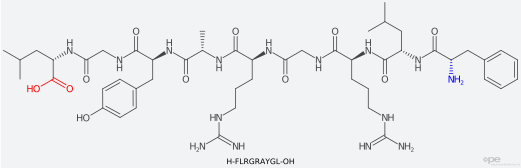
Antigen Peptide EBV EBNA3A HLA-B*08:01 (FLRGRAYGL) for stimulation of human EBV EBNA-3A(325-333) -specific CD8+ T-cells. The peptide is synthesised as it is presented by the MHC class I HLA-B*0801 allele.
The EBV (EBNA-3a) Peptide Pool from peptides&elephants is designed for in vitro T cell stimulation and epitope analysis in research on Epstein-Barr virus (EBV, HHV-4). This pool contains 234 synthetic 15-mer peptides, overlapping by 11 amino acids, and spans the complete sequence of EBNA-3a (Epstein-Barr nuclear antigen 3a; UniProt ID: P12977). Each unit enables the stimulation of up to 2.5 × 10⁸ peripheral blood mononuclear cells (PBMCs) and is ideal for use in ELISpot, intracellular cytokine staining (ICS), and flow cytometry-based T cell assays.
Scientific Background
EBV is a ubiquitous herpesvirus that infects more than 90% of the global population. It is the causative agent of infectious mononucleosis and is closely associated with several B cell malignancies, including post-transplant lymphoproliferative disease (PTLD), diffuse large B cell lymphoma (DLBCL), Burkitt lymphoma, and Hodgkin lymphoma.
During latency, EBV can enter different gene expression programs. Latency type III, in which all nine latent proteins are expressed, is the only form capable of transforming B cells in vitro, resulting in lymphoblastoid cell lines (LCLs). Among these latency proteins, EBNA-3a plays a supportive but non-essential role in B cell transformation:
EBV mutants lacking EBNA-3a can still transform B cells, but with significantly reduced efficiency.
EBNA-3a–deficient LCLs proliferate more slowly and show increased apoptosis compared to wild-type virus–derived LCLs.
EBNA-3a appears to regulate a subset of cellular genes, some of which overlap with those regulated by EBNA2. The two proteins can act antagonistically or cooperatively to control gene expression.
These findings position EBNA-3a as a key modulator of B cell proliferation and survival during EBV latency, and as a relevant CD8⁺ T cell target in both basic immunological studies and translational research.
Peptide pool of 234 overlapping peptides derived from a peptide scan (15mers with 11 aa overlap) through Epstein-Barr nuclear antigen 4 (EBNA3b) (UniProt ID: Q1HVG4) of Epstein-Barr virus (HHV4) for T cell assays.
One unit allows the stimulation of 2,5 x 10⁸ cells.
RYSIFFDY is a linear peptidic epitope (epitope ID 56650) studied as part of Epstein-Barr nuclear antigen 3 from Human herpesvirus 4 (Epstein Barr virus). This epitope has been studied for immune reactivity, tested in T cell assays
The EBV EBNA-3B 399–408 peptide (AVFDRKSDAK), historically also known as EBNA-4 399–408, is one of the most thoroughly validated CD8+ T-cell targets derived from Epstein-Barr nuclear antigen 3B (EBNA-3B / EBNA-4; UniProt: P03203; epitope ID: 5316) of Epstein-Barr Virus (EBV / Human Herpesvirus 4). Expressed during latent phase III infection, EBNA-3B triggers potent cytotoxic T-lymphocyte (CTL) responses. Primary presentation occurs via HLA-A*11:01, though functional literature also confirms presentation via HLA-A*03:01, providing high population coverage for human immunomonitoring assays.Key Features & BenefitsDual HLA-A Supertype Recognition: Primarily restricted by HLA-A*11:01 and cross-validated for presentation on HLA-A*03:01, enabling broad applicability across diverse demographic cohorts.Exceptionally Benchmark-Validated: Supported by an extensive evidence base of 41 peer-reviewed publications, 80 functional T-cell assays, and 13 MHC ligand binding studies.Core Control Component: Integrated as a key reference constituent in peptides&elephants' EBV Control Peptide Pool and CEF (Advanced) Peptide Pool (>95% HPLC purity).ApplicationsEBV Latent Phase Immunomonitoring: Quantifies functional cytotoxic CD8+ T-cell memory (IFN-gamma, TNF-alpha, CD107a) directed against latent viral targets in human PBMCs.Recall Controls & Assay Standardization: Serves as a gold-standard positive control in ELISpot, Fluorospot, and Intracellular Cytokine Staining (ICS) assays.MHC Multimer & Tetramer Staining: Ideal reference ligand for generating HLA-A*11:01 and HLA-A*03:01 peptide-MHC complexes to isolate and enumerate antigen-specific CD8+ T cells.
RRIYDLIEL is a linear peptidic epitope (epitope ID55620) studied as part of Epstein-Barr nuclear antigen 6 from Human herpesvirus 4 (Epstein Barr virus). This epitope has been studied for immune reactivity, tested in T cell assays and MHC ligand assays
Antigen Peptide EBV EBNA-1 407-417 (HLA-B*35:01) HPVGEADYFEY for stimulation of antigen-specific T cells in T cell assays such as ELISPOT, ICS, cytotoxity or proliferation assays. HPVGEADYFEY for stimulation of human EBV EBNA-1-specific CD8+ T-cells. The peptide is synthesised as it is presented by the MHC class I HLA-B*3501 allele. HPVGEADYFEY is a linear peptidic epitope (epitope ID24536) studied as part of Epstein-Barr nuclear antigen 1 from Human herpesvirus 4 (Epstein Barr virus). This epitope has been studied for immune reactivity, tested in T cell assays and MHC ligand assays.
EBNA1-derived peptide of HPVAEADYFEY covering 407-417 and B*35:08 molecule. HPVAEADYFEY is a linear peptidic epitope (epitope ID 227777) studied as part of Epstein-Barr nuclear antigen 1 from Human herpesvirus 4 (Epstein Barr virus). This epitope has been studied for immune reactivity, tested in T cell assays and MHC ligand assays.
EBV EBNA1-derived peptide of HPVGDADYFEY covering 407-417 and B*35:08 molecule. HPVGDADYFEY is a linear peptidic epitope (epitope ID 24525) studied as part of Epstein-Barr nuclear antigen 1 from Human herpesvirus 4 (Epstein Barr virus). This epitope has been studied for immune reactivity, tested in T cell assays and MHC ligand assays
The Epstein-Barr virus (EBV), also called Human herpes virus 4 (HHV-4), is a virus of the herpes family (which includes Herpes simplex virus and Cytomegalo virus). On infecting the B-lymphocyte, the linear virus genome circularizes and the virus subsequently persists within the cell as an episome. The virus can execute several distinct programs of gene expression which can be broadly categorized as being lytic cycle or latent cycle. The lytic cycle or productive infection results in staged expression of a host of viral proteins with the ultimate objective of producing infectious virions. Formally, this phase of infection does not inevitably lead to lysis of the host cell as EBV virions are produced by budding from the infected cell. The latent cycle (lysogenic) programs are those that do not result in production of virions.
RPQKRPSCI is a linear peptidic epitope studied as part of Epstein-Barr nuclear antigen 1 from Human herpesvirus 4 (Epstein Barr virus). This epitope has been studied for immune reactivity, tested in T cell assays.
Pool of 158 overlapping peptides derived from a peptide scan (15mers with 11 aa overlap) through Epstein-Barr nuclear antigen 1 (EBNA1) (Uniprot ID: P03211) of Epstein-Barr virus (HHV4) of Epstein-Barr virus (HHV4) for T cell assays.
One unit allows the stimulation of 2,5 x 10⁸ cells.
The EBV EBNA-2 Peptide Pool from peptides&elephants is designed for reliable stimulation and detection of EBV-specific T-cell responses in immunological research. The pool consists of 119 overlapping peptides (15-mers with an 11-amino-acid overlap) spanning Epstein–Barr nuclear antigen 2 (EBNA2) from Epstein–Barr virus strain B95-8 (UniProt ID: P12978). The Epstein-Barr virus is also known as Human herpesvirus 4 (HHV-4).
EBNA2 is one of the earliest viral proteins expressed after infection of B cells and acts as a central transcriptional regulator that reprograms host and viral gene expression. Through interactions with numerous sites in the host genome, EBNA2 cooperates with EBNA-LP to activate key cellular pathways, including transient activation of the MYC proto-oncogene, which drives early B-cell proliferation and supports survival during the establishment of EBV latency.
EBNA2 activity also contributes to the transition from the initial Wp promoter–driven transcription toward the Cp promoter–controlled latency program IIb, in which multiple EBV nuclear antigens are expressed from a polycistronic transcript. This shift allows the virus to balance rapid proliferation with controlled persistence.
Learn more about EBNA2-mediated transcriptional reprogramming and MYC regulation during early EBV infection in the Peptide Insights section of peptides&elephants.
Applications
Suitable for multiple T-cell–based assays, including:
ELISpot assays
Intracellular cytokine staining (ICS)
FluoroSpot assays
T-cell proliferation assays
Immune monitoring in EBV research
Capacity
One unit allows the stimulation of 2.5 × 10⁸ cells.
The EBV EBNA-2 Peptide Pool provides a comprehensive tool for studying EBV-specific immune responses, latency establishment, and virus-host interactions in basic and translational research.
The EBV EBNA-3A 379–387 peptide (RPPIFIRRL; epitope ID: 55252) is an immunodominant, structurally defined, and widely cited CD8+ T-cell target in viral immunology. Derived from Epstein-Barr nuclear antigen 3A (EBNA-3A / EBNA-3; UniProt: P12977) of Epstein-Barr Virus (EBV / Human Herpesvirus 4), this nonamer sequence represents a critical cytotoxic target during latent viral infection. Featuring the amino acid sequence RPPIFIRRL, this catalog peptide is strictly presented via HLA-B*07:02—a highly prevalent allele in global populations—and serves as a primary model antigen in structural immunology with multiple published 3D crystal structures (PDB IDs: 6VMX, 5WMO).Key Features & BenefitsHLA-B*07:02 Anchor Nonamer: Optimized for high-affinity presentation, enabling precise CD8+ cytotoxic T-cell activation, TCR profiling, and tetramer generation in HLA-B*07:02-positive donor cohorts.Exceptionally Benchmark-Validated: Supported by an extensive evidence base of over 66 peer-reviewed publications, 157 functional T-cell assays, 29 MHC ligand binding studies, and multiple resolved crystal structures (PDB: 6VMX, 5WMO).Core Control Component: Integrated as an essential reference constituent in peptides&elephants' EBV (EBNA-3a) Peptide Pool, CEF (Classic) Peptide Pool (>95% HPLC), and CEF (Advanced) Peptide Pool (>95% HPLC).ApplicationsEBV Latent Phase Immunomonitoring: Measures functional CD8+ Effector and Effector Memory T-cell activation (IFN-gamma, TNF-alpha, CD107a) against latent nuclear viral antigens in human PBMCs.Recall Controls & Assay Standardization: Serves as a gold-standard positive control in ELISpot, Fluorospot, and Intracellular Cytokine Staining (ICS) assays.Structural & Biophysical Research: Ideal reference ligand for generating HLA-B*07:02 peptide-MHC complexes for TCR docking studies, structural biology, and MHC multimer staining.
HLA-B35-restricted epitope from Epstein-Barr Virus latent nuclear antigen 3A (458-466) for stimulation of antigen-specific T cells in T cell assays such as ELISPOT, ICS, cytotoxity or proliferation assays.
This peptide represents an HLA-A2-restricted epitope of the Epstein-Barr virus nuclear antigen 3 (EBNA 3). EBNA 3 is a transcriptional regulatory protein that promotes B cell activation through the RBP-Jk pathway. This peptide is used in the study of immunotherapy for solid organ transplant patients.
The EBV EBNA-3A 603–611 peptide (RLRAEAQVK) is a widely characterized CD8+ T-cell epitope derived from Epstein-Barr nuclear antigen 3A (EBNA-3A / EBNA-3; UniProt: P12977; epitope ID: 54728) of Epstein-Barr Virus (EBV / Human Herpesvirus 4). As a vital nuclear protein expressed during latent EBV infection, EBNA-3A is a primary immunotarget for cytotoxic T lymphocytes. Restricted by HLA-A*03:01, this nonamer peptide is a trusted reference tool for assessing latent T-cell memory, performing functional recall assays, and benchmarking antiviral immune responses.Key Features & BenefitsHLA-A*03:01 Restriction: High-affinity CD8+ anchor nonamer optimized for precise cytotoxic T-cell stimulation and TCR profiling in HLA-A*03:01-positive cohorts.Extensively Validated Target: Supported by 28 peer-reviewed publications and tested across 37 functional T-cell assays and 3 MHC ligand binding studies.Core Control Component: Integrated as a key reference constituent in peptides&elephants' EBV (EBNA-3a) Peptide Pool, EBV Control Peptide Pool, CEF (Classic) Peptide Pool, and CEF (Advanced) Peptide Pool (>95% HPLC purity).ApplicationsEBV Latent Phase Immunomonitoring: Quantifies functional CD8+ T-cell memory (IFN-gamma, TNF-alpha, CD107a) directed against latent viral antigens in human PBMCs.Positive Control & Assay Validation: Serves as a reliable control in ELISpot, Fluorospot, and Intracellular Cytokine Staining (ICS) assays.MHC Multimer & Tetramer Staining: Ideal reference ligand for generating HLA-A*03:01 peptide-MHC complexes to isolate and enumerate antigen-specific CD8+ T cells.
LLDFVRFMGV is a linear peptidic epitope (epitope ID 37153) studied as part of Epstein-Barr nuclear antigen 6 from Human herpesvirus 4 (Epstein Barr virus) and Other Human herpesvirus 4 (Epstein Barr virus) protein from Human herpesvirus 4 (Epstein Barr virus). This epitope has been studied for immune reactivity, tested in T cell assays and MHC ligand assays
QPRAPIRPI is a linear peptidic epitope (epitope ID 51946) studied as part of Epstein-Barr nuclear antigen 6 from Human herpesvirus 4 (Epstein Barr virus). This epitope has been studied for immune reactivity, tested in T cell assays and MHC ligand assays
The peptide EBV EBNA2 280–290 (TVFYNIPPMPL) from peptides&elephants is a synthetic antigenic epitope derived from Epstein–Barr nuclear antigen 2 (EBNA2) of Epstein–Barr virus (Human herpesvirus 4). EBNA2 is a central transcriptional regulator expressed during early stages of EBV infection and plays a crucial role in the establishment of viral latency and the reprogramming of infected B cells.For a deeper understanding of the biological role of EBNA2 in early EBV infection and viral transcriptional control, explore the EBV Peptide Insights section by peptides&elephants.
EBV EBNA2 280–290 corresponds to a linear T-cell epitope (IEDB ID 67007) located within the EBNA2 protein (UniProt ID: P12978). It has been experimentally studied for immune reactivity and evaluated in multiple functional T-cell assays. The epitope is presented in the context of HLA-DRB1*01:01, enabling recognition by CD4⁺ T cells.
Experimental studies have demonstrated positive immune responses in several assay formats, including interferon-γ (IFNγ) release assays, T-cell proliferation assays, and cytotoxicity assays. These findings indicate that the peptide can effectively stimulate EBNA2-specific T-cell responses and is therefore suitable for applications in cellular immunology and EBV research.
Because EBNA2 is a key driver of early transcriptional reprogramming in EBV-infected cells, peptides derived from this protein are valuable tools for studying virus-host interactions, T-cell immunity to EBV, and immune recognition of latency-associated antigens.
Applications
Stimulation of EBV-specific T cells
ELISpot and FluoroSpot assays
Intracellular cytokine staining (ICS)
T-cell proliferation assays
Cytotoxicity assays
Epitope validation and immune monitoring in EBV research
QAKWRLQTL is a linear peptidic epitope (epitope ID50298) studied as part of Epstein-Barr nuclear antigen 3 from Human herpesvirus 4 (Epstein Barr virus). This epitope has been studied for immune reactivity, tested in T cell assays and MHC ligand assays
The EBV EBNA-3B 416–424 peptide (IVTDFSVIK), historically referenced as EBNA-4 416–424, is one of the most immunodominant and extensively characterized CD8+ T-cell targets in viral immunology. Derived from Epstein-Barr nuclear antigen 3B (EBNA-3B / EBNA-4; UniProt: P03203; epitope ID: 29466) of Epstein-Barr Virus (EBV / Human Herpesvirus 4), this nonamer sequence represents a major cytotoxic target during latent viral infection. Featuring the amino acid sequence IVTDFSVIK, this peptide is predominantly presented via the HLA-A3 supertype (specifically HLA-A*11:01 and HLA-A*68:01), making it a high-value tool for broad population-wide immune profiling.Key Features & BenefitsBroad HLA-A Supertype Restriction: Dual-restricted by HLA-A*11:01 and HLA-A*68:01 alleles, providing high population coverage across diverse demographic cohorts.Extensively Validated Benchmark: Backed by a large evidence base of 55 peer-reviewed publications, 105 functional T-cell assays, and 21 MHC ligand binding studies.Core Control Component: Integrated as an essential reference constituent in peptides&elephants' EBV Control Peptide Pool, CEF (Classic) Peptide Pool, and CEF (Advanced) Peptide Pool (>95% HPLC purity).ApplicationsEBV Latent Phase Immunomonitoring: Measures functional CD8+ T-cell memory (IFN-gamma, TNF-alpha, CD107a) directed against latent nuclear antigens in human PBMCs.Recall Controls & Assay Standardization: Serves as a gold-standard positive control in ELISpot, Fluorospot, and Intracellular Cytokine Staining (ICS) assays.MHC Multimer & Tetramer Staining: Ideal reference ligand for generating HLA-A*11:01 and HLA-A*68:01 peptide-MHC complexes to isolate and enumerate antigen-specific CD8+ T cells.
EBNA3C-derived peptide of EENLLDFVRF covering 281-290 and B*44:05 molecule. The EBV EBNA3C 281-290 (HLA-B*44:05) peptide recognizes CD8 T cells, and can be used in the analysis of individual antigen-specific T cells. EENLLDFVRF is a linear peptidic epitope (epitope ID11804) studied as part of Epstein-Barr nuclear antigen 6 from Human herpesvirus 4 (Epstein Barr virus). This epitope has been studied for immune reactivity, tested in T cell assays and MHC ligand assays