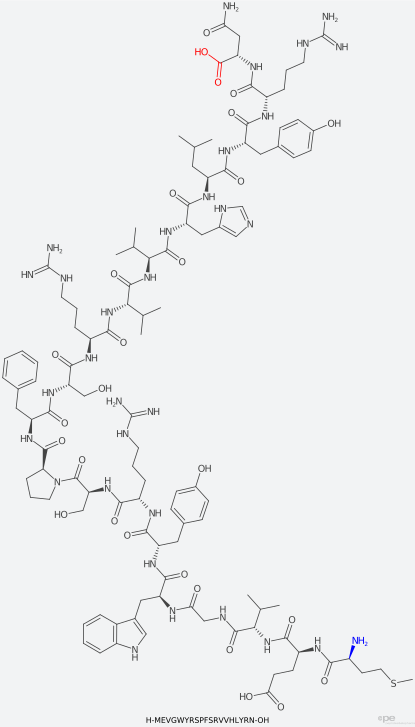
Structure of MOG 35-53
Logo for Neuroscience
Neuroscience

MOG 35-53 MEVGWYRSPFSRVVHLYRN

€226.30*

Prices excl. VAT plus shipping costs
Available, delivery time: 3 weeks
sterile and endotoxin free
Delivery Format: The product is supplied freeze dried.
Purity: 95% HPLC-MS
Caution: For research use only. Not for use in humans.
Amount in mg
1
Add to Cart
Product number: EP09863_1

Description

Myelin oligodendrocyte glycoprotein (MOG) 35-53, a minor component of CNS myelin, is expressed in central nervous system myelin which produces a relapsing-remitting neurological diesease with extensive plague-like demyelination. It is believed to be a target autoantigen in multiple sclerosis. MOG 35-53 peptide is an immunodominant epitope of MOG that induces strong T and B cell responses and Induces experimental autoimmune encephalomyelitis in rodents. A single injection of this peptide produces a relapsing-remitting neurologic disease with extensive plaque-like demyelination. This Cysteine containing MOG (35-53) peptide can be use to induced polyclonal anti-MOG(35-53) antibody production in rabbits with high specificity, high affinity, and high titer indicating its high purity, as well as suitability for peptide-coated ELISA and Western blot assay. Immunization with MOG (35-53) suppresses spontaneous regeneration of dopaminergic neurons injured with MPTP.

TechData

Sequence: MEVGWYRSPFSRVVHLYRN
Gene: mog
Delivery: 3 weeks
C-Terminus: OH
N-Terminus: H
Amount: 1 mg
Counterion: TFA
Protein: Myelin-oligodendrocyte glycoprotein
Species: Mouse, Rat
Indication: Neuroscience
Purity: 95% HPLC-MS
Skip product gallery

More MOG peptides

MOG 1-21, rat
Myelin oligodendrocyte glycoprotein (MOG) 1 - 21, a minor component of CNS myelin, is expressed in central nervous system myelin which produces a relapsing-remitting neurological diesease with extensive plague-like demyelination. It is believed to be a target autoantigen in multiple sclerosis. MOG 1 - 21 peptide is an immunodominant epitope of MOG that induces strong T and B cell responses and Induces experimental autoimmune encephalomyelitis in rodents. A single injection of this peptide produces a relapsing-remitting neurologic disease with extensive plaque-like demyelination. This Cysteine containing MOG (1 - 21) peptide can be use to induced polyclonal anti-MOG(1 - 21) antibody production in rabbits with high specificity, high affinity, and high titer indicating its high purity, as well as suitability for peptide-coated ELISA and Western blot assay. Immunization with MOG (1 - 21) suppresses spontaneous regeneration of dopaminergic neurons injured with MPTP.

From €279.90*
MOG 1-26, human
Myelin oligodendrocyte glycoprotein (MOG) 1 - 26, a minor component of CNS myelin, is expressed in central nervous system myelin which produces a relapsing-remitting neurological diesease with extensive plague-like demyelination. It is believed to be a target autoantigen in multiple sclerosis. MOG 1 - 26 peptide is an immunodominant epitope of MOG that induces strong T and B cell responses and Induces experimental autoimmune encephalomyelitis in rodents. A single injection of this peptide produces a relapsing-remitting neurologic disease with extensive plaque-like demyelination. This Cysteine containing MOG (1 - 26) peptide can be use to induced polyclonal anti-MOG(1 - 26) antibody production in rabbits with high specificity, high affinity, and high titer indicating its high purity, as well as suitability for peptide-coated ELISA and Western blot assay. Immunization with MOG (1 - 26) suppresses spontaneous regeneration of dopaminergic neurons injured with MPTP.

From €306.60*
MOG 101-108, rat
Myelin oligodendrocyte glycoprotein (MOG) 101 - 108, a minor component of CNS myelin, is expressed in central nervous system myelin which produces a relapsing-remitting neurological diesease with extensive plague-like demyelination. It is believed to be a target autoantigen in multiple sclerosis. MOG 101 - 108 peptide is an immunodominant epitope of MOG that induces strong T and B cell responses and Induces experimental autoimmune encephalomyelitis in rodents. A single injection of this peptide produces a relapsing-remitting neurologic disease with extensive plaque-like demyelination. This Cysteine containing MOG (101 - 108) peptide can be use to induced polyclonal anti-MOG(101 - 108) antibody production in rabbits with high specificity, high affinity, and high titer indicating its high purity, as well as suitability for peptide-coated ELISA and Western blot assay. Immunization with MOG (101 - 108) suppresses spontaneous regeneration of dopaminergic neurons injured with MPTP.

From €105.00*
MOG 101-120, human, mouse
Myelin oligodendrocyte glycoprotein (MOG) 101 - 120, a minor component of CNS myelin, is expressed in central nervous system myelin which produces a relapsing-remitting neurological diesease with extensive plague-like demyelination. It is believed to be a target autoantigen in multiple sclerosis. MOG 101 - 120 peptide is an immunodominant epitope of MOG that induces strong T and B cell responses and Induces experimental autoimmune encephalomyelitis in rodents. A single injection of this peptide produces a relapsing-remitting neurologic disease with extensive plaque-like demyelination. This Cysteine containing MOG (101 - 120) peptide can be use to induced polyclonal anti-MOG(101 - 120) antibody production in rabbits with high specificity, high affinity, and high titer indicating its high purity, as well as suitability for peptide-coated ELISA and Western blot assay. Immunization with MOG (101 - 120) suppresses spontaneous regeneration of dopaminergic neurons injured with MPTP.

From €226.30*
MOG 14-39, human
Myelin oligodendrocyte glycoprotein (MOG) 14 - 39, a minor component of CNS myelin, is expressed in central nervous system myelin which produces a relapsing-remitting neurological diesease with extensive plague-like demyelination. It is believed to be a target autoantigen in multiple sclerosis. MOG 14 - 39 peptide is an immunodominant epitope of MOG that induces strong T and B cell responses and Induces experimental autoimmune encephalomyelitis in rodents. A single injection of this peptide produces a relapsing-remitting neurologic disease with extensive plaque-like demyelination. This Cysteine containing MOG (14 - 39) peptide can be use to induced polyclonal anti-MOG(14 - 39) antibody production in rabbits with high specificity, high affinity, and high titer indicating its high purity, as well as suitability for peptide-coated ELISA and Western blot assay. Immunization with MOG (14 - 39) suppresses spontaneous regeneration of dopaminergic neurons injured with MPTP.

From €306.60*
MOG 183-191
Myelin oligodendrocyte glycoprotein (MOG) 183-191, a minor component of CNS myelin, is expressed in central nervous system myelin which produces a relapsing-remitting neurological diesease with extensive plague-like demyelination. It is believed to be a target autoantigen in multiple sclerosis. MOG 183-191 peptide is an immunodominant epitope of MOG that induces strong T and B cell responses and Induces experimental autoimmune encephalomyelitis in rodents. A single injection of this peptide produces a relapsing-remitting neurologic disease with extensive plaque-like demyelination. This Cysteine containing MOG (183-191) peptide can be use to induced polyclonal anti-MOG(183-191) antibody production in rabbits with high specificity, high affinity, and high titer indicating its high purity, as well as suitability for peptide-coated ELISA and Western blot assay. Immunization with MOG (183-191) suppresses spontaneous regeneration of dopaminergic neurons injured with MPTP.

From €105.00*
MOG 27-50, human
Myelin oligodendrocyte glycoprotein (MOG) 27-50, a minor component of CNS myelin, is expressed in central nervous system myelin which produces a relapsing-remitting neurological diesease with extensive plague-like demyelination. It is believed to be a target autoantigen in multiple sclerosis. MOG 27-50 peptide is an immunodominant epitope of MOG that induces strong T and B cell responses and Induces experimental autoimmune encephalomyelitis in rodents. A single injection of this peptide produces a relapsing-remitting neurologic disease with extensive plaque-like demyelination. This Cysteine containing MOG (27-50) peptide can be use to induced polyclonal anti-MOG(27-50) antibody production in rabbits with high specificity, high affinity, and high titer indicating its high purity, as well as suitability for peptide-coated ELISA and Western blot assay. Immunization with MOG (27-50) suppresses spontaneous regeneration of dopaminergic neurons injured with MPTP.

From €306.60*
MOG 35-51
Myelin oligodendrocyte glycoprotein (MOG) 35-51, a minor component of CNS myelin, is expressed in central nervous system myelin which produces a relapsing-remitting neurological diesease with extensive plague-like demyelination. It is believed to be a target autoantigen in multiple sclerosis. MOG 35-51 peptide is an immunodominant epitope of MOG that induces strong T and B cell responses and Induces experimental autoimmune encephalomyelitis in rodents. A single injection of this peptide produces a relapsing-remitting neurologic disease with extensive plaque-like demyelination. This Cysteine containing MOG (35-51) peptide can be use to induced polyclonal anti-MOG(35-51) antibody production in rabbits with high specificity, high affinity, and high titer indicating its high purity, as well as suitability for peptide-coated ELISA and Western blot assay. Immunization with MOG (35-51) suppresses spontaneous regeneration of dopaminergic neurons injured with MPTP.

From €226.30*
MOG 35-52
Myelin oligodendrocyte glycoprotein (MOG) 35-52, a minor component of CNS myelin, is expressed in central nervous system myelin which produces a relapsing-remitting neurological diesease with extensive plague-like demyelination. It is believed to be a target autoantigen in multiple sclerosis. MOG 35-52 peptide is an immunodominant epitope of MOG that induces strong T and B cell responses and Induces experimental autoimmune encephalomyelitis in rodents. A single injection of this peptide produces a relapsing-remitting neurologic disease with extensive plaque-like demyelination. This Cysteine containing MOG (35-52) peptide can be use to induced polyclonal anti-MOG(35-52) antibody production in rabbits with high specificity, high affinity, and high titer indicating its high purity, as well as suitability for peptide-coated ELISA and Western blot assay. Immunization with MOG (35-52) suppresses spontaneous regeneration of dopaminergic neurons injured with MPTP.

From €226.30*
Tip
MOG 35-55
Myelin oligodendrocyte glycoprotein (MOG) is a minor but immunologically significant component of central nervous system (CNS) myelin. The MOG 35–55 peptide with the amino acid sequence MEVGWYRSPFSRVVHLYRNGK represents an immunodominant epitope, and is believed to be a target autoantigen in multiple sclerosis. It is widely used in neuroimmunology to model autoimmune demyelinating diseases. This peptide is a well-established inducer of experimental autoimmune encephalomyelitis (EAE) in rodents, closely mimicking the relapsing–remitting course of multiple sclerosis (MS). Immunization with MOG 35–55 triggers strong T cell and B cell responses, leading to plaque-like demyelination in the CNS. Due to its cysteine-containing sequence, MOG 35–55 can also be used to generate high titers of polyclonal anti-MOG antibodies in rabbits, demonstrating excellent specificity and affinity. These antibodies are suitable for peptide-coated ELISA and Western blot assays. In addition to autoimmune research, MOG 35–55 has been investigated in neurodegenerative models involving the neurotoxin MPTP (1-methyl-4-phenyl-1,2,3,6-tetrahydropyridine). MPTP selectively damages dopaminergic neurons in the substantia nigra, reproducing many biochemical and pathological features of Parkinson’s disease. In such models, immunization with MOG 35–55 has been shown to suppress spontaneous regeneration of dopaminergic neurons, making it a versatile tool for both autoimmune and neuroregenerative research.  Applications: Induction of EAE models for multiple sclerosis research Generation of anti-MOG antibodies ELISA and Western blot assays Studies on CNS demyelination and neuronal regeneration

From €133.20*
MOG 35-55, human
Myelin oligodendrocyte glycoprotein (MOG) is a transmembrane protein located on the outermost surface of the myelin sheath, making it a primary target of autoimmune responses in the central nervous system (CNS). peptides&elephants' human MOG 35–55 peptide with the amino acid sequence MEVGWYRPPFSRVVHLYRNGK corresponds to the immunologically relevant region of the human sequence, which differs slightly from the rodent variant commonly used in experimental autoimmune encephalomyelitis (EAE) models. Although the rodent MOG 35–55 peptide is a classical inducer of EAE in mice and rats, the human counterpart provides valuable translational relevance for studying species-specific immune recognition, T cell epitope mapping, and cross-reactivity in humanized systems. This peptide supports investigations into multiple sclerosis (MS) pathogenesis, helping to dissect the molecular mechanisms that underlie autoantibody and T cell responses to native human myelin components. Highly purified and precisely synthesized, MOG 35–55, human is suitable for in vitro T cell assays, peptide–MHC binding studies, and cross-species immunological comparisons, providing a reliable foundation for translational neuroimmunology research.

From €133.20*
MOG 37-50
Myelin oligodendrocyte glycoprotein (MOG)37-50, a minor component of CNS myelin, is expressed in central nervous system myelin which produces a relapsing-remitting neurological diesease with extensive plague-like demyelination. It is believed to be a target autoantigen in multiple sclerosis. MOG 37-50 peptide is an immunodominant epitope of MOG that induces strong T and B cell responses and Induces experimental autoimmune encephalomyelitis in rodents. A single injection of this peptide produces a relapsing-remitting neurologic disease with extensive plaque-like demyelination. This Cysteine containing MOG 37-50 peptide can be use to induced polyclonal anti-MOG 37-50 antibody production in rabbits with high specificity, high affinity, and high titer indicating its high purity, as well as suitability for peptide-coated ELISA and Western blot assay. Immunization with MOG 37-50 suppresses spontaneous regeneration of dopaminergic neurons injured with MPTP. Multiple Sclerosis: MOG 37-50 induced experimental autoimmune encephalomyelitis (EAE) rodent models

From €105.00*
MOG 37–54, mouse, rat
Myelin oligodendrocyte glycoprotein (MOG) 37–54, a minor component of CNS myelin, is expressed in central nervous system myelin which produces a relapsing-remitting neurological diesease with extensive plague-like demyelination. It is believed to be a target autoantigen in multiple sclerosis. MOG 37-54 peptide is an immunodominant epitope of MOG that induces strong T and B cell responses and Induces experimental autoimmune encephalomyelitis in rodents. A single injection of this peptide produces a relapsing-remitting neurologic disease with extensive plaque-like demyelination. This Cysteine containing MOG (37–54) peptide can be use to induced polyclonal anti-MOG(37–54) antibody production in rabbits with high specificity, high affinity, and high titer indicating its high purity, as well as suitability for peptide-coated ELISA and Western blot assay. Immunization with MOG (37–54) suppresses spontaneous regeneration of dopaminergic neurons injured with MPTP. Multiple Sclerosis: MOG 37–54 induced experimental autoimmune encephalomyelitis (EAE) rodent modelsMyelin oligodendrocyte glycoprotein (MOG) 37–54, a minor component of CNS myelin, is expressed in central nervous system myelin which produces a relapsing-remitting neurological diesease with extensive plague-like demyelination. It is believed to be a target autoantigen in multiple sclerosis. MOG 37-54 peptide is an immunodominant epitope of MOG that induces strong T and B cell responses and Induces experimental autoimmune encephalomyelitis in rodents. A single injection of this peptide produces a relapsing-remitting neurologic disease with extensive plaque-like demyelination. This Cysteine containing MOG (37–54) peptide can be use to induced polyclonal anti-MOG(37–54) antibody production in rabbits with high specificity, high affinity, and high titer indicating its high purity, as well as suitability for peptide-coated ELISA and Western blot assay. Immunization with MOG (37–54) suppresses spontaneous regeneration of dopaminergic neurons injured with MPTP. Multiple Sclerosis: MOG 37–54 induced experimental autoimmune encephalomyelitis (EAE) rodent models

From €133.20*
MOG 38-53
Myelin oligodendrocyte glycoprotein (MOG) 38-53, a minor component of CNS myelin, is expressed in central nervous system myelin which produces a relapsing-remitting neurological diesease with extensive plague-like demyelination. It is believed to be a target autoantigen in multiple sclerosis. MOG 38-53 peptide is an immunodominant epitope of MOG that induces strong T and B cell responses and Induces experimental autoimmune encephalomyelitis in rodents. A single injection of this peptide produces a relapsing-remitting neurologic disease with extensive plaque-like demyelination. This Cysteine containing MOG 38-53 peptide can be use to induced polyclonal anti-MOG(38-53) antibody production in rabbits with high specificity, high affinity, and high titer indicating its high purity, as well as suitability for peptide-coated ELISA and Western blot assay. Immunization with MOG (38-53) suppresses spontaneous regeneration of dopaminergic neurons injured with MPTP. Multiple Sclerosis: MOG 38-53 induced experimental autoimmune encephalomyelitis (EAE) rodent modelsMyelin oligodendrocyte glycoprotein (MOG) 38-53, a minor component of CNS myelin, is expressed in central nervous system myelin which produces a relapsing-remitting neurological diesease with extensive plague-like demyelination. It is believed to be a target autoantigen in multiple sclerosis. MOG 38-53 peptide is an immunodominant epitope of MOG that induces strong T and B cell responses and Induces experimental autoimmune encephalomyelitis in rodents. A single injection of this peptide produces a relapsing-remitting neurologic disease with extensive plaque-like demyelination. This Cysteine containing MOG 38-53 peptide can be use to induced polyclonal anti-MOG(38-53) antibody production in rabbits with high specificity, high affinity, and high titer indicating its high purity, as well as suitability for peptide-coated ELISA and Western blot assay. Immunization with MOG (38-53) suppresses spontaneous regeneration of dopaminergic neurons injured with MPTP. Multiple Sclerosis: MOG 38-53 induced experimental autoimmune encephalomyelitis (EAE) rodent models

From €133.20*
MOG 38-55
Myelin oligodendrocyte glycoprotein (MOG) 38 - 55, a minor component of CNS myelin, is expressed in central nervous system myelin which produces a relapsing-remitting neurological diesease with extensive plague-like demyelination. It is believed to be a target autoantigen in multiple sclerosis. MOG 38 - 55 peptide is an immunodominant epitope of MOG that induces strong T and B cell responses and Induces experimental autoimmune encephalomyelitis in rodents. A single injection of this peptide produces a relapsing-remitting neurologic disease with extensive plaque-like demyelination. This Cysteine containing MOG (38 - 55) peptide can be use to induced polyclonal anti-MOG(38 - 55) antibody production in rabbits with high specificity, high affinity, and high titer indicating its high purity, as well as suitability for peptide-coated ELISA and Western blot assay. Immunization with MOG (38 - 55) suppresses spontaneous regeneration of dopaminergic neurons injured with MPTP. Multiple Sclerosis: MOG 38 - 55 induced experimental autoimmune encephalomyelitis (EAE) rodent modelsMyelin oligodendrocyte glycoprotein (MOG) 38 - 55, a minor component of CNS myelin, is expressed in central nervous system myelin which produces a relapsing-remitting neurological diesease with extensive plague-like demyelination. It is believed to be a target autoantigen in multiple sclerosis. MOG 38 - 55 peptide is an immunodominant epitope of MOG that induces strong T and B cell responses and Induces experimental autoimmune encephalomyelitis in rodents. A single injection of this peptide produces a relapsing-remitting neurologic disease with extensive plaque-like demyelination. This Cysteine containing MOG (38 - 55) peptide can be use to induced polyclonal anti-MOG(38 - 55) antibody production in rabbits with high specificity, high affinity, and high titer indicating its high purity, as well as suitability for peptide-coated ELISA and Western blot assay. Immunization with MOG (38 - 55) suppresses spontaneous regeneration of dopaminergic neurons injured with MPTP. Multiple Sclerosis: MOG 38 - 55 induced experimental autoimmune encephalomyelitis (EAE) rodent models

From €133.20*
MOG 38-60, human
Myelin oligodendrocyte glycoprotein (MOG) 38 - 60, a minor component of CNS myelin, is expressed in central nervous system myelin which produces a relapsing-remitting neurological diesease with extensive plague-like demyelination. It is believed to be a target autoantigen in multiple sclerosis. MOG 38 - 60 peptide is an immunodominant epitope of MOG that induces strong T and B cell responses and Induces experimental autoimmune encephalomyelitis in rodents. A single injection of this peptide produces a relapsing-remitting neurologic disease with extensive plaque-like demyelination. This Cysteine containing MOG (38 - 60) peptide can be use to induced polyclonal anti-MOG(38 - 60) antibody production in rabbits with high specificity, high affinity, and high titer indicating its high purity, as well as suitability for peptide-coated ELISA and Western blot assay. Immunization with MOG (38 - 60) suppresses spontaneous regeneration of dopaminergic neurons injured with MPTP. Multiple Sclerosis: MOG 38 - 60 induced experimental autoimmune encephalomyelitis (EAE) rodent modelsMyelin oligodendrocyte glycoprotein (MOG) 38 - 60, a minor component of CNS myelin, is expressed in central nervous system myelin which produces a relapsing-remitting neurological diesease with extensive plague-like demyelination. It is believed to be a target autoantigen in multiple sclerosis. MOG 38 - 60 peptide is an immunodominant epitope of MOG that induces strong T and B cell responses and Induces experimental autoimmune encephalomyelitis in rodents. A single injection of this peptide produces a relapsing-remitting neurologic disease with extensive plaque-like demyelination. This Cysteine containing MOG (38 - 60) peptide can be use to induced polyclonal anti-MOG(38 - 60) antibody production in rabbits with high specificity, high affinity, and high titer indicating its high purity, as well as suitability for peptide-coated ELISA and Western blot assay. Immunization with MOG (38 - 60) suppresses spontaneous regeneration of dopaminergic neurons injured with MPTP. Multiple Sclerosis: MOG 38 - 60 induced experimental autoimmune encephalomyelitis (EAE) rodent models

From €279.90*
MOG 40-54
Myelin oligodendrocyte glycoprotein (MOG) 40-54, a minor component of CNS myelin, is expressed in central nervous system myelin which produces a relapsing-remitting neurological diesease with extensive plague-like demyelination. It is believed to be a target autoantigen in multiple sclerosis. MOG 40-54 peptide is an immunodominant epitope of MOG that induces strong T and B cell responses and Induces experimental autoimmune encephalomyelitis in rodents. A single injection of this peptide produces a relapsing-remitting neurologic disease with extensive plaque-like demyelination. This Cysteine containing MOG 40-54 peptide can be use to induced polyclonal anti-MOG(40-54) antibody production in rabbits with high specificity, high affinity, and high titer indicating its high purity, as well as suitability for peptide-coated ELISA and Western blot assay. Immunization with MOG (40-54) suppresses spontaneous regeneration of dopaminergic neurons injured with MPTP. Multiple Sclerosis: MOG 40-54 induced experimental autoimmune encephalomyelitis (EAE) rodent modelsMyelin oligodendrocyte glycoprotein (MOG) 40-54, a minor component of CNS myelin, is expressed in central nervous system myelin which produces a relapsing-remitting neurological diesease with extensive plague-like demyelination. It is believed to be a target autoantigen in multiple sclerosis. MOG 40-54 peptide is an immunodominant epitope of MOG that induces strong T and B cell responses and Induces experimental autoimmune encephalomyelitis in rodents. A single injection of this peptide produces a relapsing-remitting neurologic disease with extensive plaque-like demyelination. This Cysteine containing MOG 40-54 peptide can be use to induced polyclonal anti-MOG(40-54) antibody production in rabbits with high specificity, high affinity, and high titer indicating its high purity, as well as suitability for peptide-coated ELISA and Western blot assay. Immunization with MOG (40-54) suppresses spontaneous regeneration of dopaminergic neurons injured with MPTP. Multiple Sclerosis: MOG 40-54 induced experimental autoimmune encephalomyelitis (EAE) rodent models

From €133.20*